

I Ching Online Oracle: The Book of Changes, Ancient Wisdom, and the Art of Seeing Change
Published on 20. September 2025
The I Ching is not merely a book. It is the oldest Chinese canon, which has endured for millennia whilst retaining its power. It combines two dimensions: a precise philosophical treatise and a living oracular tool. Some turn to it to understand the hidden laws of change; others to catch a glimpse of a possible future. And there is no contradiction in this: as it says in the:
‘Wings’: ‘The wise man sees the signs and understands the times.’
In the 21st century, amidst the clamour of technology, the I Ching remains a quiet but clear voice that helps us to pause, look deeper and listen to ourselves. It can be read as a book of wisdom or as an oracle – in either case, it reveals what is important right now. And perhaps also what is only just beginning to emerge.
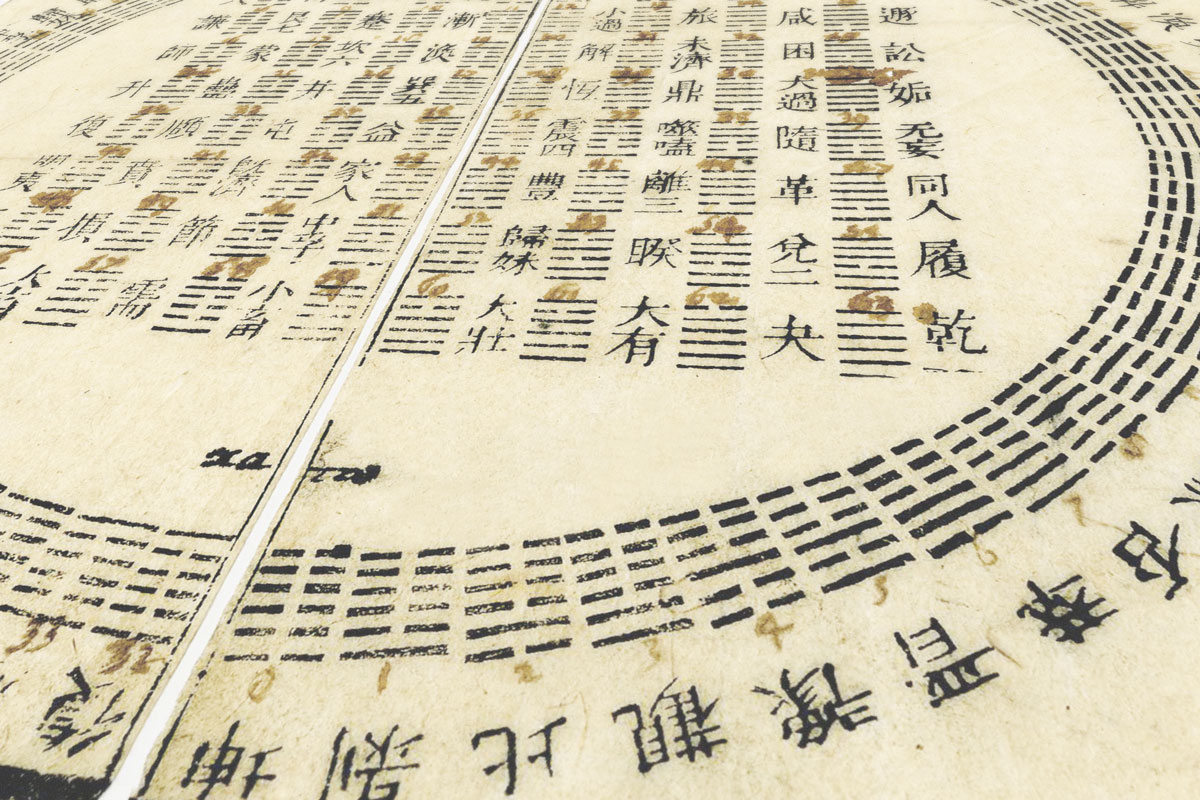
History
The history of the I Ching begins in the mists of antiquity, when people sought answers from spirits and in nature. As early as the Shang Dynasty (c. 16th–11th centuries BC), diviners carved symbols into tortoise shells and animal bones to record questions and answers. These symbols were the first steps towards a system that would later be known as the Zhouyi.
During the Zhou Dynasty (c. 11th–3rd centuries BC), the structure took on its definitive form: 64 hexagrams, each with a name, a judgement and an image. They reflected not only natural phenomena but also the laws governing human life.
Over time, the Zhouyi became part of the ‘Five Classics’ of the Confucian tradition and thus required reading for men of noble birth. Confucius (551–479 BC) is credited with commentaries known as the ‘Ten Wings’, which transformed the work from a manual of divination into a philosophical treatise on change. As one of the ‘Wings’ states:
Change is the means by which Heaven and Earth sustain all living things.
Trigrams, hexagrams and lines as catalysts for change
The I Ching is based on a clearly structured system of 64 hexagrams – combinations of eight fundamental trigrams (Bagua), each of which conveys its own image and meaning.
A hexagram consists of three central elements: the name, which reflects the essence of a situation; the judgement (Tuàn Zhuàn), which sets the general direction of the interpretation; and the image (Xiàng Zhuàn), which unfolds the symbolism through parallels in nature and human life.
These building blocks work together like a compass: they not only show where one stands, but also the direction in which things may move. Every line, every combination is an impulse – a hint as to how the flow of events might change if one is prepared to perceive it.
Trigrams
Pinyin Symbol Element / Image Description
Qián (乾) ☰ Heaven, creative power Embodying pure Yang, the active principle, creative power and leadership. Associated with strength, initiative, steadfastness and nobility.
Kūn (坤) ☷ Earth, receptive force Pure Yin, symbolising gentleness, fertility and support. Receives and nourishes, providing the foundation for growth and harmony.
Zhèn (震) ☳ Thunder, Excitement Movement and awakening. Symbolises sudden action, impulse, and the ability to shake things up and break the deadlock.
Xùn (巽) ☴ Wind / Wood, Penetration Flexibility, gentle yet persistent penetration. Associated with influence, the dissemination of ideas and adaptability.
Kǎn (坎) ☵ Water, danger Depth, trials, hidden currents. Symbolises difficulties requiring caution and inner steadfastness.
Lí (離) ☲ Fire, clarity Light, understanding, culture. Embodies enlightenment, clear vision, the ability to discern and to illuminate the path.
Gèn (艮) ☶ Mountain, Stillness Immobility, completion, boundaries. Symbolises the ability to pause, maintain stability and find inner peace.
Duì (兌) ☱ Lake, Joy Joy, communication, openness. Embodies harmony, the joy of exchange, gentle persuasiveness and friendliness.
These are joined by six lines (Yáo), each of which describes a stage in the development of a situation. The lines are read from bottom to top – from the foundation to the summit, from the present towards a possible future. This direction of reading plays a crucial role in understanding the dynamics of change and in forming the hexagram, which reflects the potential of what is to come.