

Gobi Desert Agate: Meaning, Properties and Origin

Daria Berezhna
Founder, ZENstore.at ·
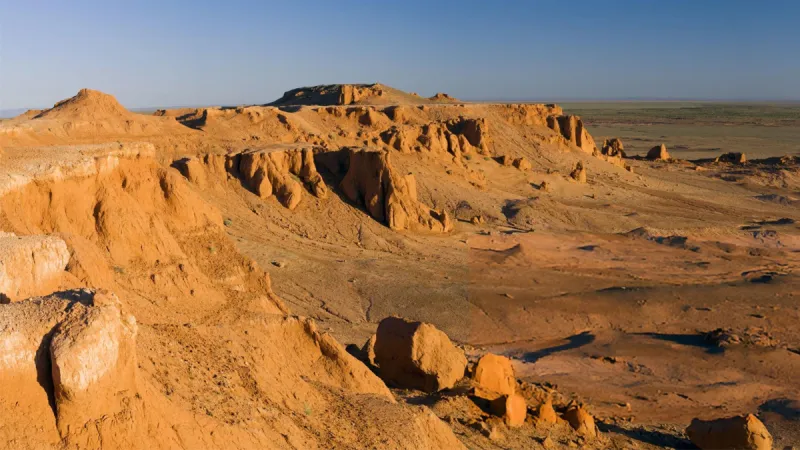
Agate is a banded variety of chalcedony, a microcrystalline form of quartz. Gobi agate is found in the Gobi Desert across Mongolia and Inner Mongolia in northern China, where wind-blown sand has polished the stones naturally over centuries. This guide explains how agate forms, what sets Gobi agate apart and what the stone has meant to different cultures. You'll also find its traditional healing properties, the zodiac signs and chakras linked to it, how to tell if agate is real and what to look for when you buy agate.
How agate forms
Agate grows inside cavities in volcanic rock. Silica-rich water seeps in and leaves behind thin layers of tiny quartz crystals, one after another. Whenever the solution changes, the next layer takes on a slightly different colour or density, and that's how the bands appear. Some run straight, others close into rings. With a hardness of 6.5 to 7 on the Mohs scale, agate holds up well in jewellery you wear every day.
What makes Gobi agate special
The volcanic rock of the Gobi weathered away long ago. The harder agate nodules stayed behind and now lie loose on the desert floor, where the wind keeps sanding them smooth. Uncut, they often have a soft, satin-like sheen that no tumbling machine can quite copy. Collectors in China and Mongolia have prized these stones for generations, especially those from the Alxa region. Eye agates are among the most sought after: their bands circle a central point and look strikingly like an eye. Colours range from honey yellow and blue-grey to almost black, with green turning up less often.
Agate meaning in history and culture
The name goes back to Sicily. The Greek philosopher Theophrastus wrote that the stone was first found along the river Achates, known today as the Dirillo.
In Mesopotamia, craftsmen cut seals and beads from agate, and in ancient Egypt it was worn as an amulet. In Tibet, agate was used to make dzi beads, whose "eyes" are still regarded as powerful protection.
Around the Mediterranean and in the Middle East, people carried an agate with an eye to ward off the evil eye. Agate, or aqeeq, also holds a special place in Islamic tradition, and the Prophet Muhammad is said to have worn a ring set with it.
In Germany, the town of Idar-Oberstein has been cutting agate since the 15th century and grew into one of Europe's best-known gemstone centres.
Agate properties: what the stone is believed to do
In crystal healing, agate is seen as a grounding stone. It's said to bring calm during restless times and help you stay centred. Eye agates are worn mainly for protection. Green agate is associated with balance and fresh starts, while darker banded stones stand for steadiness.
Different colours are linked to different chakras: green to the heart chakra, brown and black to the root chakra, blue-grey to the throat chakra. The zodiac signs most often connected with agate are Gemini and Virgo.
These beliefs come from tradition and personal experience. They aren't scientifically proven and shouldn't replace medical care.
Three Gobi agate pendants
- Desert Eye: An eye agate with two faces. One side is nearly black with an amber core, the other has pale rings around a honey-coloured centre. Light and shadow in a single stone.
- Green Agate Talisman: 30 mm, from Mongolia. Soft green tones that bring to mind the steppe in spring. A stone for calm and new beginnings.
- Desert Wind: A slim, elongated shape. Fine white lines cross in its dark grey-green middle, while blue and honey bands fan out towards the ends, like tracks the wind leaves in the sand.
How to tell if agate is real
Real agate feels cool to the touch and warms up slowly against your skin. Its bands are never perfectly even, and you'll often spot small inclusions or hairline cracks. Glass tends to look too smooth, and plastic feels noticeably lighter. Many agates on the market are dyed, particularly the very bright blue, pink and purple ones. Hold the stone up to a torch: if colour has pooled in cracks or around the drill hole, it has been treated.
Buying agate: what to look for
Look for a clear note on where the stone comes from and photos of every side, especially with two-sided stones. The size in millimetres helps you picture the pendant properly, since agate often looks bigger in close-up shots than it does around your neck. To care for it, a soft dry cloth is all you need. Keep it away from perfume and cleaning products, which can damage both the stone and the cord, and store it apart from harder gems like diamond or sapphire to avoid scratches.